One model, one view
Chatbots and multi-model apps have models answer you — one at a time or side by side. The models never talk to each other, so nothing gets challenged, defended, or corrected.
rebuttalsecond opinionChorix is a local desktop app that runs two or three AI models in conversation — you design the relationship, watch them reason turn by turn, and approve, steer, or stop any handoff from your desk or your phone.
Works with the model providers you already pay for
Multi-model apps put models side by side answering you — they never speak to each other. Agent frameworks let them speak — if you can code, and mostly without you in the room. The empty seat in this market is the conductor’s.
Chatbots and multi-model apps have models answer you — one at a time or side by side. The models never talk to each other, so nothing gets challenged, defended, or corrected.
rebuttalsecond opinionAgent frameworks let models pass work to each other — but oversight is a callback you program, not a button you press. When it drifts, you read logs after the fact.
Orchestrating models today is an engineering job — not something you can set up, watch, and steer in minutes.
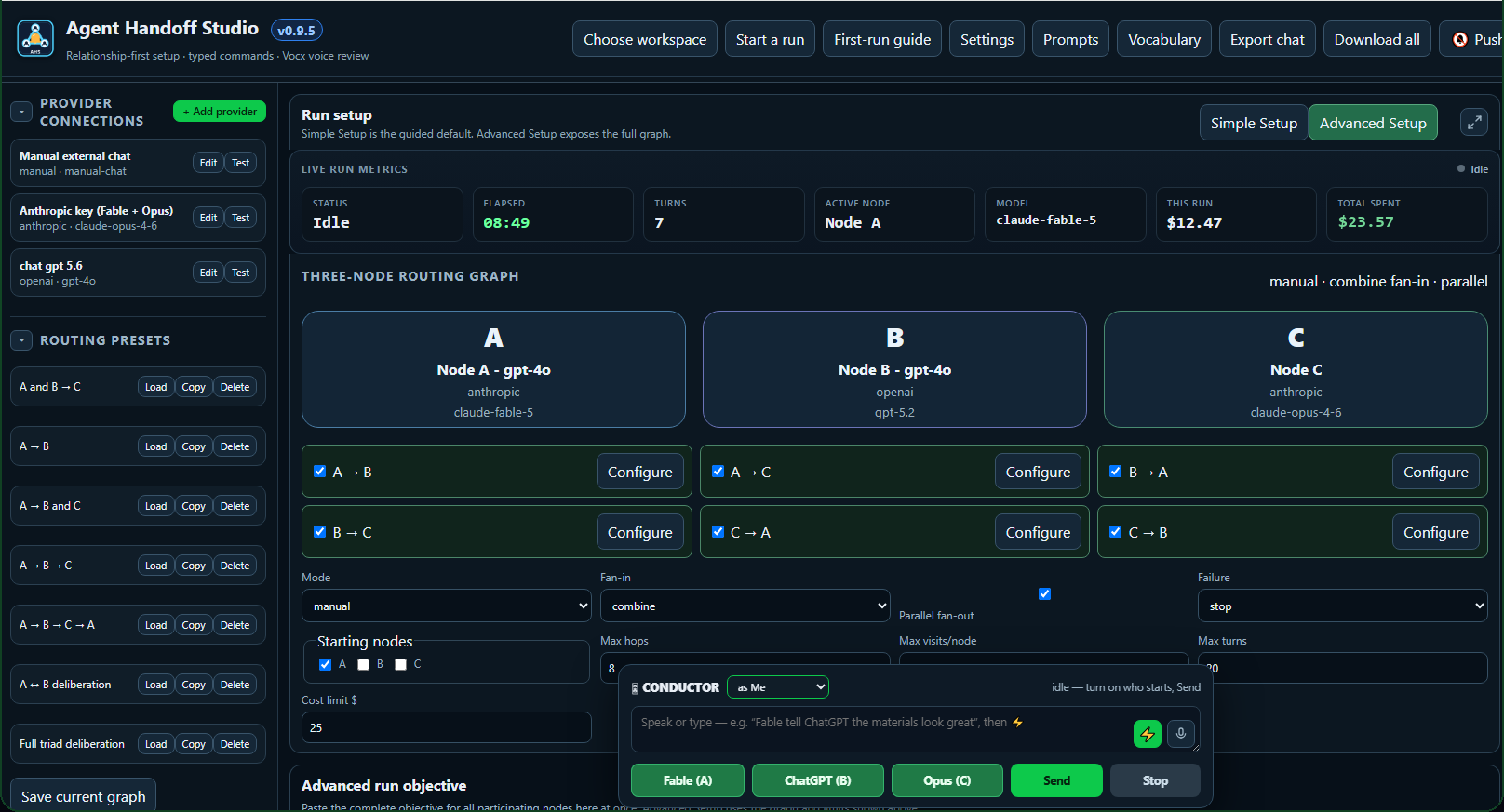
The actual console mid-session — three seats wired, routes armed, the conductor dock standing by, and every dollar of the run tracked live.
The desk is where you wire it — seats, routes, limits, and spend, all in one place.
Chorix gives you one place to design a model-to-model conversation, watch it unfold, and approve, steer, or stop it — from your desk or your phone. You conduct; the models are the bench; the final call is always yours. And you can take a seat in the conversation yourself — a manual node lets you, or any model you can paste into, occupy a chair as a full participant.
Pick how the models talk — an A ⇄ B correction loop or an A → B → C cycle — assign a model to each, set an objective and a turn limit. No code.
See how it worksPoint each node at OpenAI, Anthropic, or Gemini — mix vendors in a single conversation. Bring your own key. Or make a node manual and sit in the seat yourself.
Mark any handoff critical and the run pauses for your decision before the next model continues.
A flagged decision pushes to your phone. Approve, reject, or type a steer — and the models keep going without you at the keyboard.
Keep a tool-armed agent — Claude Code, Codex — off stage on your desktop. It watches the whole run, pulls and writes files, and hands you what it finds through its own window. It never takes a seat, and everything it offers enters the conversation through you. Chorix itself was built this way.
A built-in library of one-line prompt directives — plus Vocx: dictate your trade's words, approve them once, and the app learns to hear them right before you ever run live.
A simple flow: set the relationship, run the models, supervise every handoff, and keep what works.
Choose the relationship, assign a model to each node, and set the objective and turn limit — all in a guided, no-code setup.
Each model replies in turn and hands the conversation to the next. You see every message land, with a live turn count and cost.
Gate any handoff. Get a push on your phone, then approve, reject, or type an instruction that steers the next model's reply.
Save presets, build a stack from the prompt library, and train your voice vocabulary so every future run starts sharper.
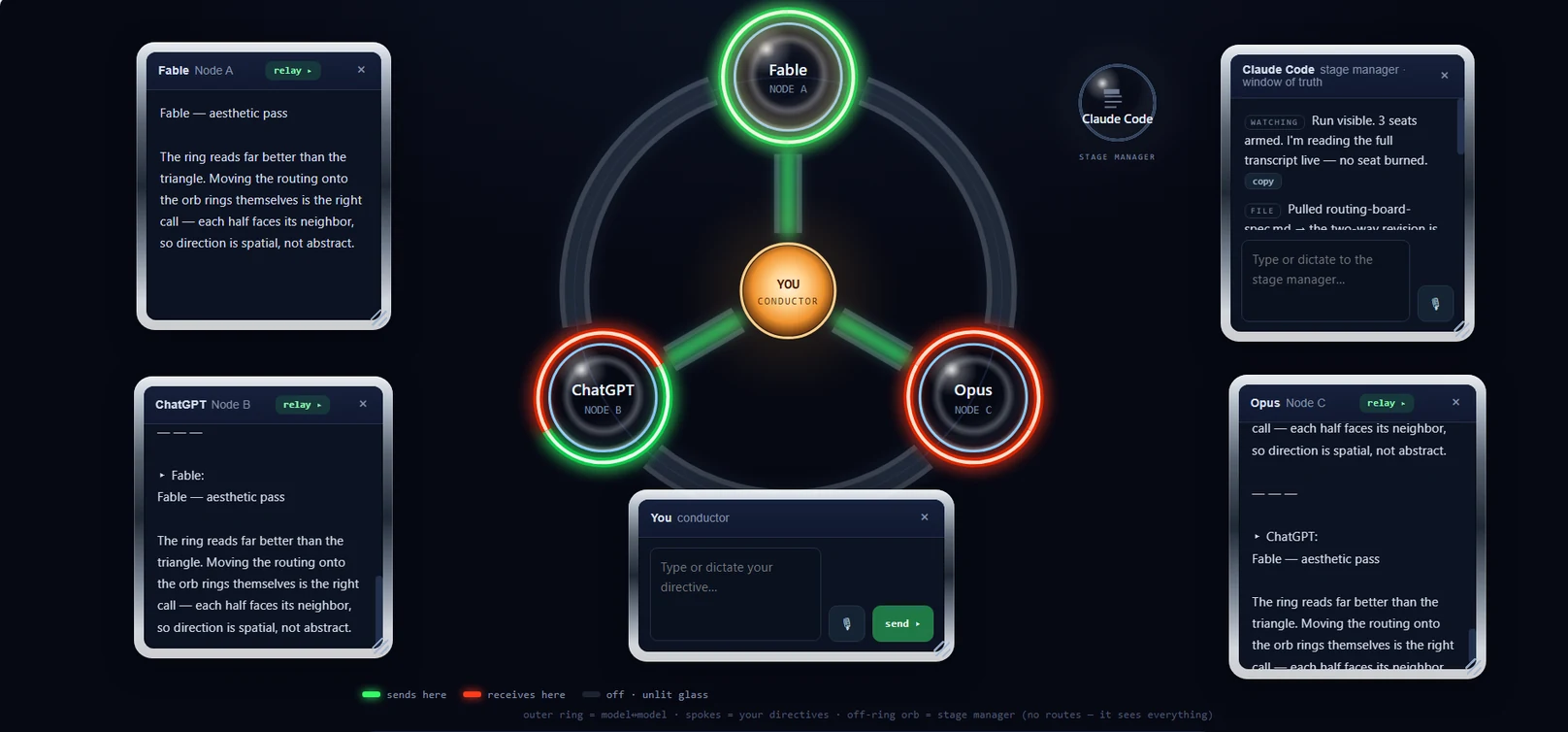
A run in flight — Fable fanning out to both seats, replies landing in their windows, the stage manager watching from the wings.
Green sends. Red receives. Every route, every hand-off, every window — yours.
It runs locally on Windows right now. Here's what's live, and what's next — no overclaiming.
Code-signed installer and a macOS build.
Start with one conversation, watch it reason, and keep the setups that work.
Assign two models opposite sides of a question and watch them argue — a fast way to compare how models reason.
One model drafts, another critiques and corrects — a review loop you can watch, gate, and steer.
Probe how different models handle the same objective, prompt, or edge case — side by side, turn by turn.
It runs today on Windows, bring-your-own-key. Here's where it's headed.
Two-model runs, human approval gates, phone notifications and approvals, plus the prompt and voice libraries — all local.
A one-click install without the security warning, live auto-correct during dictation, and a Mac build.
A relay so you can approve over cellular, not just your home network — and a paid Pro tier.
No. It's a desktop app for running and supervising conversations between models. You bring the models and your API key; it gives you the room, the controls, and the human gate.
Windows and your own API key from OpenAI, Anthropic, or Google. It runs locally — your key and your conversations stay on your machine; only the model calls you make go out.
Yes. Mark any handoff critical and the run pauses for you. You get a push on your phone and can approve, reject, or type an instruction that steers the next model's reply.
Vocx lets you dictate setup and train a vocabulary of your trade's words — soffit, rafter, purlin — so the app hears them correctly. You can sit down with the mic and approve terms before you ever run live.
Get the Windows build, bring your own key, and conduct your first supervised model-to-model conversation. Chorix: you conduct the chorus. Put the models to work — keep the last word.